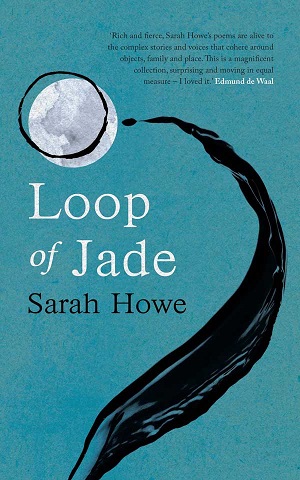
Published in 2015 by Chatto and Windus
Loop of Jade is a TS Eliot prize winning debut collection from Sarah Howe, whose earlier successes included the Eric Gregory Trust Fund Award for young poets. Howe, who was born in Hong Kong in 1983 has described herself as, “a Chinese-British poet.” Her mother, who was born in China and abandoned at birth, was taken to Hong Kong in 1949 where she was raised by an adoptive mother and her father is British. The family settled in the UK in 1991.
The theme of the book centres around a series of journeys which includes that of Howe’s Chinese born mother to Hong Kong and later England, and Howe’s own journey to visit the Chinese mainland in 2004. Howe describes her poetry as, “the place where I explored my Chineseness, something that otherwise had no place in my life.”
The collection begins with a beautiful vignette entitled Mother’s Jewellery Box, whose twin lids open to reveal the first of many personal poems which explore Howe’s dual heritage. The poems are a Chinese-Anglo hybrid-fusion, formed like intricately carved beads, of various styles and sizes, strung out throughout the book and ultimately resulting in the metaphorical loop of jade which gives the book its title. In the poem, Loop of Jade, we discover the reasoning behind the selection of this particular piece of jewellery, “Jade was meant to bind.” Throughout the collection, Howe attempts to bind the two halves of her biological and cultural heritage.
The poems explore other dual/twin themes such as; mother/daughter, youth/age, male/female, reality/myth, security/insecurity, acceptance/rejection, home/away, familiar/unfamiliar, belonging/out of place and many others, they are told from either the perspective of Howe or her mother.
Many of the poems are short, such as the atmospheric Earthward, “I watched the shadowplay of trees / against the blinds one October – in the way sometimes you stare” and the melodic A Painting, “I watched the turquoise pastel / melt between your fingerpads” whilst the longer prose poems are more traditional in style and tend to have a Chinese mythological focus. No two poems are of the same theme and there is no pattern to the style, no obvious methodology to their content or arrangement.
In Crossing from Guangdong Howe explores the Anglo references prominent throughout the journey and with which she can both relate to and identify with from, “the humid strains of Frank Sinatra,” to the meeting of East and West in the architecture and culture. Howe said in a 2016 interview with The South China Morning Post, “without the colonial history of Hong Kong, I wouldn’t exist.”
However, the books ultimate success lies within the intertwining Chinese proverbs, folklore and imagery which are deftly woven into the poetry and which portray a sense of the poet’s ultimate quest to decode the unknown familiar within her hybrid cultural roots and the historic struggles of the female within both (and all) cultures. The poem Tame begins with a Chinese proverb about geese being more profitable than daughters and the custom that a midwife, “placed near the birthing bed a box of ashes scraped from the hearth so that, if female, the baby might be easily smothered.” The poem is a beautiful homage to Howe’s unknown Chinese grandmother and a reference to the abandonment of Howe’s mother at birth.
Loop of Jade is an elegant, poignant and original poetry collection which is a delight to read despite some of the later poems within the collection which are heavily bound with western mythology and academic references. Though these later poems often feel somewhat out of place alongside the more simpler and easy to read Chinese influenced poems one must question if this is the effect the poet was seeking to achieve. I suspect it was.
 Shirley-Anne Kennedy