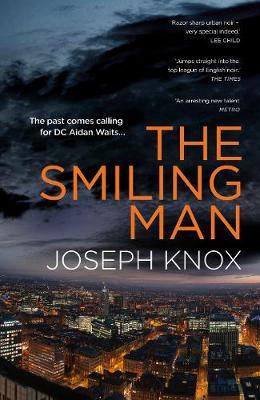
When I enrolled on the Creative Writing BA (Hons) degree course at the University of Bolton I had no idea that my third-year work placement, as part of the Writers at Work module, would allow me the opportunity to meet and interview a bestselling author. However, as part of my placement with the Rochdale based media/news organisation, All Across the Arts, that is exactly what I experienced when Joseph Knox, the Sunday Times bestselling author of the literary crime thrillers Sirens and The Smiling Man, visited Middleton Junction library in March 2018 to talk about his latest novel.
Knox, who grew up in Stoke and Manchester, has battled with insomnia since childhood. His parents gave him novels to fill his sleepless nights and later, notebooks and pens with which to write his own stories. It was not until he was in his twenties, while as a guest at a mysterious party hosted by an anonymous man, that he had the idea for Sirens. He describes it as a eureka moment. The idea of a mysterious host reminded him of Jay Gatsby in F. Scott Fitzgerald’s novel, The Great Gatsby. Knox rushed home and wrote his idea for a novel down. The result, eight years later, was the literary debut of Aidan Waits, a Manchester police detective in a case involving police corruption and a disappearing girl. The novel was a bestseller, a Manc Noir delight which also held appeal for readers who were not usually attracted to the genre.
I talked with him about his writing process.
Congratulations on the second book. Eight years for the first one, two years for the second, was it a different writing experience this time?
Completely different, yes. The first book was written over eight years because I wrote it mainly in my lunch hours while trying to escape from the day job. I would just run out and drink two black coffees. I would not eat anything because if I did, I would be too happy, and I needed to write five hundred angry words. So that process was very long and went on forever. As well as that, I think I was trying to learn how to do it. With the second book I was really lucky to take six months sabbatical from work, and that was when I wrote almost all of the book. That is where there was a huge difference between to the two writing experiences because Sirens is, even now to me in my head, a series of fragments pieced together. In a way, I feel that The Smiling Man is much more a cohesive book and reads more easily. I could really sit with each scene as long as I wanted to, and I felt I had got every last drop out of it. Through those six months I was so terrified I wouldn’t be finished before I went back to work, I wrote for sixteen to twenty hours every day, and at the end of it I could barely remember my own name.
Are you methodical in your approach to writing? Do you plan every part of the story before you start or do you fly by the seat of your pants so to speak?
Seat of my pants, I’m afraid. I feel that is the only way I can write naturally because I feel that if I did a plan the characters would not be acting like they should be, they would be acting how I had decided that they should act. Funnily enough, because the first one took eight years and I was terrified the second one would as well, I actually did sit down and wrote a plan from beginning to end. I tried to bring in all the characters I wanted to deal with, all the themes, all of this. When I got to the end of it I thought, I don’t want to write this book. And so, The Smiling Man has nothing to do with that plan. Not one thing that was in that plan made it into that book because for me I need the danger of maybe this won’t work and also the excitement of not knowing what comes next.
When you wrote the first book I believe there was a ‘Gatsby’ moment. You were at a party and you thought, ‘Gatsby, Daisy, neighbour’ and you immediately had the idea for Sirens. Was there such a moment with The Smiling Man?
Not in exactly the same way. The case itself is based on a real life unsolved murder which took place in 1960s/70s Australia. It’s a really weird story where an anonymous man travelled to this small town in coastal Australia and was seen in various parts of the town that day and his body was found later. When they investigated they found he had no identification and all the labels had been cut out of the clothes he had on his person. I saw that and immediately jumped on it for several reasons. The first was that it was a very interesting, exciting concept for a book that an anonymous man would be murdered. I discovered there is actually a nickname for these kinds of persons. You see it every now and again in the press. It’s usually a man, sometimes women, who are found dead but usually in ways where they have gone completely out of their way to remain anonymous. It is usually impossible to identify them unless someone comes forward. For me, that is fascinating and throws up a lot of questions. The other reason it was exciting for me to look at that case was that my protagonist, Aidan Waits, is plagued with questions of identity. He grew up in care and in The Smiling Man he discovers a man who has cut away his own identity and discarded it in a way. Whereas Aidan is the opposite, he had his identity torn from him against his will and has been making it up as he goes along ever since. I thought that as he is looking into the identity of this mysterious man we could be answering the questions of Aidan’s own identity as well. It worked for me on two levels and throughout the book that question of who Aidan really is creeps up on him.
I don’t know if you have any plans for a third book in the series?
Yes.
I enjoyed the Manc Noir in The Smiling Man, the little touches, the familiar Mancunian sayings such as ‘curtain twitchers’ etc. In places it was really raw, such as with the politically incorrect Sutty character, when he described another character as being, ‘unable to get a hard on in a high school.’ Did you have to think about whether or not to include lines like that in the story?
No. I think people come to me, read me in a way, for that irrelevant crap humour. What I am always trying to do is to write my books in the most beautiful, eloquent, magically impressive way possible. I will bang my head against a wall for twenty hours a day until I can get a scene as good as I can get it. So that’s a lofty ambition when I am trying to write about the scum of the earth and that’s where those two things collide where hopefully I can get a balance.
I think you have achieved that. There is some beautiful writing such as ‘the paper cut smile’. There were parts of the book where I stopped to appreciate the writing before I read on. It was filmatic, so visual. As a reader, when walking down the corridor in the Palace Hotel with Aidan, I felt the tension, my heart was racing. It was an easy book to get in to, you draw the reader in and you balance Sutty well. Despite the beautiful descriptive writing it is also a hard book to read because you have references to child abuse in it. The imagery affects the reader emotionally.
Just thinking about it makes me well up.
It must be hard to write. You take the reader there and allow our imaginations to fill in the pieces.
I hope so. Every writer has a place where they draw the line. I think my line is a little further than a lot of people, but I am not interested in… I think my books are, in my mind, much more tasteful and reserved than those which revolve around serial killers. There are a lot of crime novels when a lot of the book is the nastiest way someone can kill a woman and that just doesn’t interest me. I am interested in people. What I love about crime fiction is trying to use it as a means to investigate what people are like and get into everyone’s dirty little secrets, to find out everyone’s hopes and fears and dreams and things like that. No one can ask those questions and step into people’s lives like a detective and that is why the books to me are so interesting. Although The Smiling Man does concern Aidan, quite a lot a lot of it is him investigating the lives of other people, and things do move forward.
I must admit I did have my reservations when I first picked up the book. I thought it might go the way you said a lot of the crime fiction often does, and it was a relief to discover that this book was different. Have you researched the police in order to write a detective?
Unfortunately, with Sirens I was speaking with a detective and there were some helpful suggestions there but when they found out the book would be about police corruption, as a lot of Sirens is, he rescinded his support. From there I went alone. My main research is reading as much as possible and trying to pay attention to people because police officers, criminals, murderers etc., are just people, probably pushed to an extreme level. I think if you can make people believable then whatever they are doing will naturally follow.
Are there any authors who have influenced you?
Yeah… the one who really got me into crime was Raymond Chandler.
I thought of Chandler when I first started reading The Smiling Man. I enjoyed the fact that you have a young protagonist. At one stage I found myself trying to work Aidan’s age out.
Yeah. I don’t come out and say it, but I will give readers clues to think, like when Aidan comments, he was older than me. Aidan is my age. In my head he’s 31, in Sirens he 29 or 30. In Sirens he feels much younger in that book because I started writing it in my early twenties. I was a different person when I finished it than I was when I started it. That’s why I am so proud of The Smiling Man because I think that is where I am at now. Sometimes, I look back at Siren’s and think it is an intense read – I was a very intense young man.
I have really enjoyed talking with you. Thank you.
And with that, Knox left to give a talk to those who had gathered to meet him and sign copies of his novels while I rushed away to type up my first ever in-person interview with a best selling author.
 Shirley-Anne Kennedy